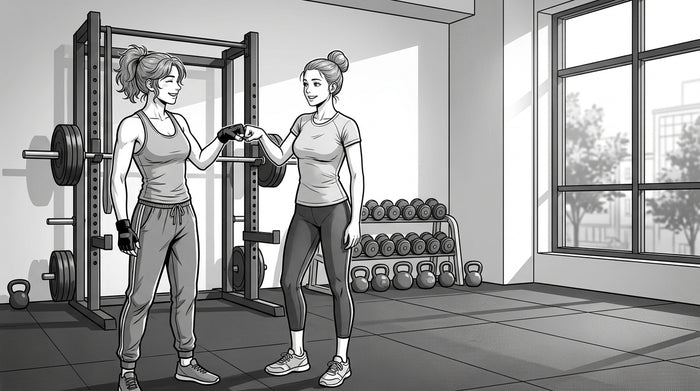
Short answer: a commercial gym is the better choice if your priority is the lowest possible monthly price and you don't mind sharing equipment at peak hours. A private gym is the better choice if your priority is time — no queues, no waiting for a rack, and a room that is yours for the hour. Most people in Berlin don't quit the gym because it was too expensive; they quit because it was too full at 18:30.
Sqwod Pod is a private, app-booked gym in Berlin with locations in Weißensee and Kollwitzkiez. You book a fully equipped private training room by the hour and use it alone, with a partner, or with your own coach. That model sits at one end of the spectrum below — so it's worth being honest about who it suits and who it doesn't.
What is the actual difference between a private gym and a commercial gym?
A commercial gym is a high-volume, shared-floor facility. It sells memberships to as many people as the space can legally hold, keeps the monthly price low, and makes the economics work on the well-documented gap between members who sign up and members who actually turn up. Think large chains, 12-month contracts, hundreds of members per floor.
A private gym is a low-volume, exclusive-access facility. Instead of selling shared access to a big floor, it sells uninterrupted access to a smaller space — either by the hour, by session, or via a capped membership. The room is yours while you're in it.
The German market gives useful context here. According to the DSSV "Eckdaten der deutschen Fitnesswirtschaft 2026" (published March 2026, compiled with Deloitte and the DHfPG), German fitness and health facilities reached a record 12.36 million members as of 31 December 2025 — up 5.6% year on year — spread across 9,647 facilities. Market penetration now stands at 14.8% of the population, up 1.0 percentage point on the year. More members spread across large shared floors is exactly the dynamic that makes peak hours feel worse each year.
Private gym vs commercial gym: side-by-side
| Commercial gym | Private gym | |
|---|---|---|
| Monthly cost | Low — the headline price is the product | Higher per hour, but you only pay for sessions you use |
| Commitment | Often 12 months with notice periods | Typically per-session or flexible packages |
| Peak-hour experience | Queues for racks and machines; sessions run long | No queue — the room is booked to you |
| Privacy | Public floor, mirrors, an audience | Fully private; train alone or with who you choose |
| Equipment breadth | Very wide — many machines, pools, saunas, classes | Focused — the essentials, always available |
| Coaching | Usually an upsell on top of membership | Bring your own coach, or book one |
| Best for | Budget-first trainees, class-lovers, off-peak schedules | Time-poor professionals, beginners, anyone self-conscious |
Is a private gym worth the money?
It depends on which resource is scarcest for you: money or time. The honest arithmetic is that a private gym costs more per hour of access. But the relevant comparison isn't price per month — it's price per completed session.
A cheap membership you use four times a month has a worse effective cost than a per-session model you use four times a month, because the cheap membership is charging you for the twenty-six days you didn't go. And if 25 minutes of a 60-minute commercial-gym session is spent waiting for equipment, you're paying for gym time you never got.
A private gym is worth it if:
- You train at peak hours (17:00–20:00) and lose real time to queues.
- You're a beginner and the public floor is the reason you're not going.
- You train with a partner or a coach and want a space to actually work in.
- Your schedule is irregular, so a fixed monthly contract wastes money.
A commercial gym is worth it if:
- Price is the deciding factor, full stop.
- You want a wide machine selection, pool, sauna, or group classes.
- You can train at off-peak times — mid-morning or early afternoon.
- You like the energy of a busy floor and find it motivating.
Do private gyms have enough equipment?
This is the most common objection, and it's fair. A commercial gym will always have more machines than a private room. The question is how many of them you actually use.
Most strength programmes run on a squat rack, a barbell, adjustable dumbbells, a bench, a cable station, and something to condition on. A well-specified private room covers all of it. What you trade away is breadth you probably weren't using — the fourth variation of a leg machine, the pool, the sauna. What you gain is that the six things you do use are never occupied.
Which is better for beginners?
For a lot of people, privately. Gym anxiety is a common reason new members stop showing up in the first few months, and a public floor is a difficult place to learn a hip hinge badly. Training in a private room removes the audience entirely, which means you can practise a movement slowly, film your form, and get it wrong without a gallery. If you want structure alongside the space, bringing a coach into a private room is far more productive than coaching on a crowded floor.
How does this work at Sqwod Pod?
Sqwod Pod is a private, app-booked gym in Berlin. You book a spacious private training room — a Pod — by the hour through the app and use it entirely alone, with a partner or up to around three guests, or with a personal trainer. There are two locations: Weißensee (Jacobsohnstraße 27, 13086 Berlin) and Kollwitzkiez (Kollwitzstraße 20, 10405 Berlin, Prenzlauer Berg). Both Pods work the same way — you book the hour in the app and the room is yours for that hour. No shared floor, no queue, and no long notice period.
If you're weighing this up more broadly, our complete guide to private gyms in Berlin covers the whole category, and why Berlin professionals are trading big gyms for private Pods looks at the time argument in more detail. If contract length is your sticking point, this piece on German gym notice periods is the relevant one.
Frequently asked questions
Is a private gym more expensive than a commercial gym?
Per hour of access, yes. Per session actually completed, often no — because private gyms are typically pay-per-use, so you aren't paying for months you don't train, and you don't lose session time queueing for equipment.
Can I bring a personal trainer to a private gym?
At Sqwod Pod, yes — you can bring your own coach or book one through the trainer marketplace. Policies vary by operator: some gyms only allow trainers they employ or license, so check the specific operator's terms before you assume you can bring your own.
Can two people share a private gym session?
Yes. A Sqwod Pod session can be used alone, with a training partner, or with up to around three guests, which makes the per-person cost considerably lower.
Do I need a long contract for a private gym?
Not at Sqwod Pod. Sessions are booked by the hour through the app, and packages are flexible — unlike the 12-month terms and multi-month notice periods common at large German chains.
Is a private gym good for beginners?
It's often the better option. Without an audience, beginners can learn technique slowly, film their form, and build a habit before ever setting foot on a busy public floor.
Try it before you decide
The comparison only settles once you've felt the difference between a full floor at 18:30 and a room that's yours. See Sqwod Pod packages and memberships, or book a single session and train in a private Berlin gym room this week. Coaches looking to work with clients in a private space can start on our For Trainers page.