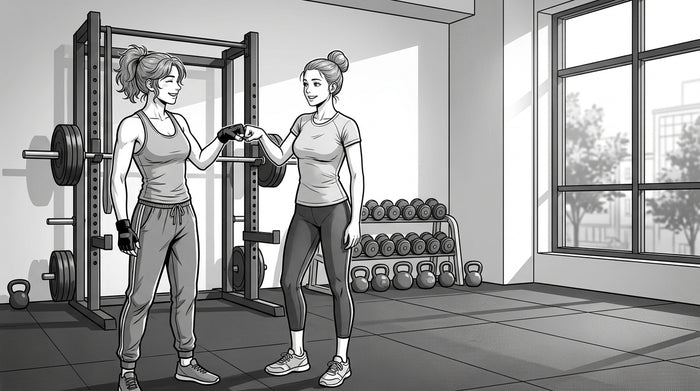
Why workplace gyms get built — and then sit empty
More companies in Berlin and beyond are investing in on-site fitness facilities to support employee well-being, reduce stress and improve focus. But plenty of these gyms end up underused, because the room gets specified before anyone asks the team what they'd actually turn up for.
So how do you build a workplace gym people use? Below is a practical checklist, plus an honest look at when an on-site gym isn't the right answer at all.
1. Survey your team before you design anything
The most common mistake is buying equipment first. Before you spend anything, ask:
- What would you actually do here? Strength, yoga, cardio, HIIT — the answers vary far more than people expect.
- When would you use it? Before work, lunch break, after hours.
- Would you want coaching, or would you rather train alone?
A short anonymous survey costs nothing and will tell you whether you need a squat rack or a quiet room with mats. It will also tell you, sometimes, that nobody wants an on-site gym — which is worth knowing before the invoice.
2. Match the equipment to the answers
Once you know what your team wants, buy for that rather than for a brochure:
- Strength: dumbbells, a rack, a bench, resistance machines
- Functional and HIIT: kettlebells, battle ropes, a sled if you have the floor
- Cardio: rower, bike, treadmill
- Mobility and recovery: mats, foam rollers, a quiet corner
Floor space is almost always the binding constraint, not budget. Be realistic about how many people can train at once.
3. Get the access hours right
Inconvenient hours are one of the most common reasons a workplace gym goes unused. A gym only open during core hours excludes shift workers, parents on school runs, and anyone with a full calendar. Consider:
- A booking system, so people know a slot is theirs
- Access outside standard office hours
- Separate blocks for quiet solo training and for group sessions
Bookable slots matter more than most employers expect — not because of the booking itself, but because certainty is what gets a session into someone's calendar and keeps it there.
4. Bring in qualified coaching
Equipment alone rarely changes behaviour. Many employees avoid a gym because they aren't confident about what to do in it, and an unfamiliar room full of unfamiliar kit makes that worse, not better. Partnering with certified trainers for group classes or one-to-one sessions addresses the actual barrier.
This is also where the evidence on workplace health programmes is clearest. The iga.Report 40 — published by the BKK Dachverband, DGUV, vdek and IKK e. V. — assessed 49 systematic reviews covering more than 900 individual studies and confirmed a positive cost-benefit ratio for workplace health promotion, with an average return on investment of 2.7 first established in the preceding iga.Report 28. But the benefit tracks participation, not sign-up: a facility nobody is coached in tends to stay a facility nobody uses.
5. Build in a reason to come back
Take-up usually needs a nudge beyond the room existing:
- Team challenges — step counts, strength goals, consistency streaks
- Recognition for milestones
- Policies that extend to remote and hybrid staff, so the benefit isn't only for people at HQ
When an on-site gym isn't the right answer
An on-site gym needs floor space, capital, maintenance, insurance and someone to own it internally. For a lot of Berlin companies — particularly hybrid teams spread across the city — the maths doesn't work, and a half-used room in the basement is a worse outcome than no room at all.
The lighter-touch alternative is to give your team access to a private gym they book by the hour, near where they actually live. Sqwod Pod is a private, app-booked gym in Berlin with locations in Weißensee and Kollwitzkiez. Each Pod is a fully-equipped private room — for that hour it belongs to the person who booked it, alone or with a colleague or a trainer. No shared floor, no fixed capital cost, and nothing to maintain.
For the tax side of structuring this as an employee benefit in Germany, see what a Berlin employer actually pays for workplace fitness, and how a workplace gym affects retention. For culture and take-up, read how workplace gyms shape company culture.
Getting started
Whichever route you take, the sequence is the same: ask your team first, design for the answers, make access genuinely convenient, and add coaching. See company wellness for how a Pod-based benefit works, or get in touch to talk it through.